Image

| Registration Type | Member Price |
|---|---|
| Early Bird Registration (Sept. 11-Oct.3) | $750 |
| General Registration (Oct. 4-Oct.17) | $850 |
| Registration Type | Member Price | Non-Member Price |
|---|---|---|
| Early Bird Registration (Sept. 11-Oct. 3) | $750 | $850 |
| General Registration (Oct. 4-Oct.17) | $850 | $950 |
Not a member? We'd love to have you join us for this event and become part of the Chorus America community! Visit our membership page to learn more, and feel free to contact us with any questions at [email protected].
| Registration Type | Non-Member Price |
|---|---|
| Early Bird Registration (Sept. 11-Oct. 3) | $850 |
| General Registration (Oct. 4-Oct.17) | $950 |
Think you should be logged in to a member account? Make sure the email address you used to login is the same as what appears on your membership information. Have questions? Email us at [email protected].
| Registration Type | Price |
|---|---|
| Individual Session | $30 each |
| All Four (4) Sessions | $110 |
*Replays with captioning will remain available for registrants to watch until November 1, 11:59pm EDT.
Member Professional Development Days are specially designed for Chorus America members. If you're not currently a member, we'd love to welcome you to this event, and into the Chorus America community! Visit our membership page to learn more about becoming a member of Chorus America, and please don't hesitate to reach out to us with any questions at [email protected].
| Registration Type | Price |
|---|---|
| Individual Session | $30 each |
| All Four (4) Sessions | $110 |
*Replays with captioning will remain available for registrants to watch until November 1, 11:59pm EDT.
| Registration Type | Price |
|---|---|
| Individual Session | $30 each |
| All Four (4) Sessions | $110 |
*Replays with captioning will remain available for registrants to watch until November 1, 11:59pm EDT.
Member Professional Development Days are specially designed for Chorus America members. If you're not currently a member, we'd love to welcome you to this event, and into the Chorus America community! Visit our membership page to learn more about becoming a member of Chorus America, and please don't hesitate to reach out to us with any questions at [email protected].

From budgeting and branding to community and long-term sustainability, six founders share what it took to bring their choruses to life.
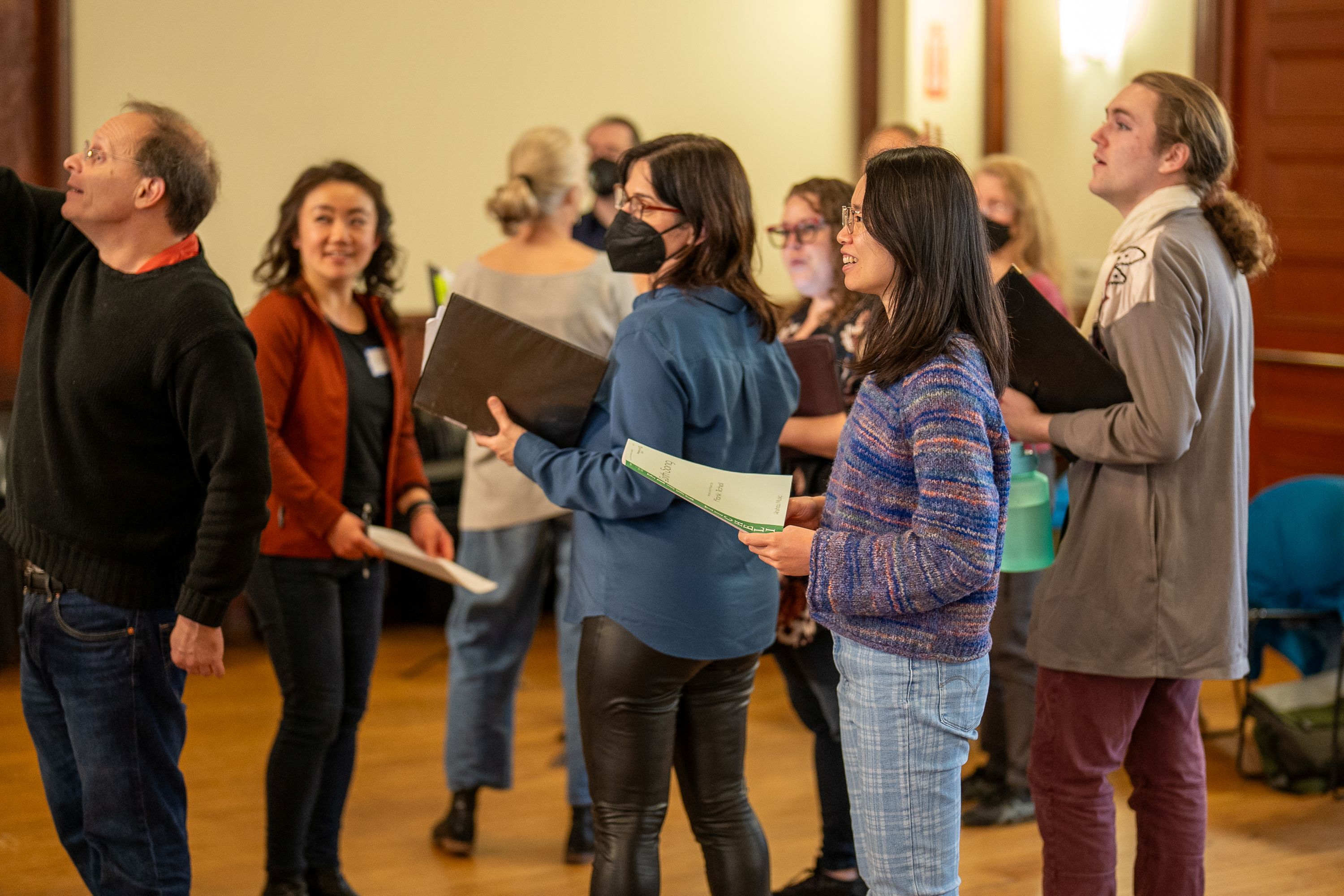
In the late summer of 2022, Heidi Ackerman picked up her phone and took a video selfie. In it, she said: “My name’s Heidi, and would you like to sing with me?” In a gesture of optimism and faith, Heidi posted the video on neighborhood pages throughout the Baltimore area. Later that fall, 29 people showed up for rehearsal.
“We didn’t even have a collaborative pianist yet,” Ackerman recalls. “That first concert celebrated the holidays and we basically did some a cappella things and some backing tracks with pre-recorded music, which is very funny looking back now with where we’ve come.”
This fall, just three years later, Charm City Sings has over 250 people singing across three ensembles.
“I just wanted to make music and community with my neighbors,” says Ackerman. “And, in a beautiful way, it’s snowballed into the organization that it has become.”
What began as one person’s invitation to sing quickly became something much bigger. But Ackerman’s story isn’t unique: Across the U.S. and Canada, new choruses are emerging in living rooms, churches, and community centers, often sparked by a single moment of courage and connection.
Starting a chorus can feel both exhilarating and daunting, especially as vision collides with the realities of logistics, marketing, and funding. We spoke with six founders who have started their choruses within the past 12 years about what it takes to launch a chorus in your community.
Every successful chorus starts not with a rehearsal space or a budget, but with a clear “why.” This vision shapes programming and outreach and ensures the chorus meets real needs while creating belonging. Without it, even talented singers may not feel invested.
Erin Guinup, who founded the Tacoma Refugee Choir in 2016, explains the importance of crafting your why with singers in mind: “There has to be a reason for that person to show up in a space. A lot of us with privilege assume that the act of singing is enough [. . .] but it has to be built for each person who’s going to come. If there are elements that say, ‘this space is not for me,’ they won’t come.”
Understanding what draws people to a chorus reveals the deeper motivations behind participation that go beyond the act of singing. Participants often seek community, mental health support, or simply a safe place to express themselves. Guinup explains, “Yes, we come to sing, but if I’m singing in a choir, I’m also coming because it allows me to express myself. This is a space where I feel like I can grow.”
Creating this kind of meaningful space requires deliberate choices about identity and purpose. “It’s tempting to want to be a choir for everyone,” Guinup warns. “The reality is it’s really hard to do that. [. . .] Being clear about who you’re going to serve and the parameters of who's going to be there can make a really big difference in how people feel in that space.”
An organization’s "why" can also be in response to a local gap. Erik Jacobs, associate artistic director of the South Loudoun Youth Chorale, founded in 2022, notes, “The pandemic happened and suddenly arts programs tanked in numbers. So we envisioned our organization to work in tandem with local schools to build back those programs.”
His co-founder, artistic director Laura Lazarevich, adds, “Our area has exploded in the last 20 to 30 years [. . .] and there actually was not a community youth choir in our county at all. So that was a big opportunity for us.”
Balancing a strong identity and a clear community need allows founders to make early decisions about programming, recruitment, and partnerships. Founders who articulate their values and target audience create cohesion for their team and clarity for participants. Before even holding a rehearsal, be able to answer these three questions:
Once the vision is set, the real work begins—translating it into programs, partnerships, and practices that endure. The first few months aren't just about music; they're about seeing whether your “why” can truly sustain both singers and the organization.
“The lives of choruses are always roller coasters of some sort, but the life of a beginning chorus has even more of a pronounced steep curve,” says Martín Benvenuto, founder and artistic director of 21V, a professional ensemble of soprano and alto voices that was founded in the Bay Area in 2021. The first year often brings equal parts excitement and uncertainty as initial momentum meets the realities of recruiting singers, securing funding, and building infrastructure.
Believing in possibility can make the difference between persevering and giving up. Kirsten Oberoi, who founded the Massachusetts-based South Shore Children’s Chorus in 2016, puts it plainly: “If you’re going into founding a chorus and you have a scarcity mindset, that’s really nerve-wracking and doesn’t necessarily lead to a ton of success. You have to go into it thinking [. . .] there’s a ton of kids [or resources], you just have to find them.”
Some founders embrace a “jump in” approach, valuing momentum over planning. Oberoi reflects, “There's a balance of ‘how much planning do I need to make sure?’ There’s going to be risk. So you have to have the mindset of ‘this is not going to fail.’”
Others wait until branding, systems, and teams are in place. “We waited a year, and it was so worth it because we were able to roll out all of our branding, our website, promo materials, and we were really able to make it seem more legit,” Lazarevich explains. This thoughtful preparation builds organizational credibility and anticipation before the first performance.
Regardless of the approach, financial and administrative groundwork is nonnegotiable when starting a chorus. Founders highlighted these six key must-dos:
The first year is about working to secure the people, funding, and momentum needed to move the mission forward. “The first years are really about building infrastructure—your first singer handbook, your first call to board members, your first articulation of your mission, vision, and values—and then you have a starting place for conversations,” says Benvenuto. Once the basics are in place, the challenge becomes not just starting strong, but sustaining.

Every leader we spoke to circled back to one idea: Longevity depends less on passion and more on building structures that carry the work forward, even when the founder can’t.
For Ackerman, that lesson came quickly. “Every day I wake up and I have probably at least 50 new emails and all of them need to be attended to,” she admits. “I’m not concerned about burning out, but I have a lot of mentors who are concerned for me.” Her solution has been to delegate more and discern “when it’s right to say yes and when it’s okay to say no.” This season, she appointed chorus managers and section leader teams to handle rehearsal notes and weekly communication. “For sustainability, for myself and this organization, I can’t keep conducting all of everything,” she says. “What happens if I get sick?”
That acknowledgment of limits is common among founders, which is where a strong board comes in. Guinup explains, “Creating a sustainable organization means having strong commitment from choir members and a strong board. [. . .] The responsibility of a board is to support the leader, because it’s hard to lead alone.” She also highlights the importance of diversity in board membership: “If your mission is about community, getting those community members who have insights that you would not have onto that board is going to be important.”
Jacobs underscores that developing a board is ongoing: “We are still in the early phases of moving from a ‘starter board’ to a more ‘transitioning board,’ identifying community leaders and allies who provide diversity of knowledge, connections, and expertise.” One practical step, he advises, is asking prospective board members to serve first on a committee—ideally development—to gauge their commitment.
For Benvenuto, sustainability has meant seeking outside perspective, something he did a couple years after founding 21V. “We did a full marketing audit and consultation, and we implemented a lot of what was suggested to us,” he says. He also brought in a fundraising consultant last year: “That gave us a very clear focus on small donations and making that more powerful.”
Long-term vision is another essential piece of the puzzle. “For anybody who starts an organization, you’re going to feel so bogged down in the weeds with all the little day-to-day things,” says Jacobs. “It’s so hard to maintain the strategic long-term vision when you’re so down in the muck every day.” SLYC now schedules staff retreats to “hash out everything for the season” and reconnect with broader goals.
And then there’s the mission itself. As Elliott emphasizes, “Your why for this organization needs to endure beyond your existence, ideally. So, it’s the continual revisiting and re-articulating of the why, the mission, the vision, so that it remains relevant as contexts inevitably shift.” For him, sustainability is about infrastructure: “Build systems that outlast any one of us, because these systems not only create inherent sustainability, but also prevent burnout, inequity, and confusion.”
Passion can start a chorus, but it takes planning, systems, and support to keep it running. While building for sustainability can feel daunting, it’s also a lens that shapes these chorus founders’ advice for the next generation.
Ask any founder what they would tell someone considering making the leap, and you’ll get a mix of encouragement and caution.
Approach with humility. “It is far harder than you could possibly expect, but totally worth it,” says Guinup. “Surround yourself with people who know a lot and approach it with as much humility as possible to glean as much information as you can."
Stay flexible and adaptable. Benvenuto recalls advice from another founder: “You’re gonna make so many mistakes. You’re gonna take one step and you’re gonna make a mistake right there. And then you’re going to stand up and you’re going to fix it.”
Keep your mission as your north star. Elliott suggests “reverse engineering” from the end: “If our chorus disappeared tomorrow, who would miss us and why?” That question reveals the true purpose of the organization and helps leaders stay grounded. Or, as he puts it more succinctly: “Build your organization as intentionally as you build your programs.”
Find allies and lean on your community. “Find your people and activate your own community and village to support you,” says Lazarevich. “I would not recommend anyone to take this on alone. That just seems impossible.”
Lead with your heart. Ackerman encourages, “If you have a vision of what you want an ensemble to look like, be confident in that. And then also know that it might not look like that for a while. There’s no shame in taking a journey that may look a little bumpy along the road, as long as that journey is led with your heart.”
The advice may be as varied as voices in your chorus, but the throughline rings true: Dream boldly, plan carefully, ask for help, and be ready for surprises. Starting a chorus will stretch your patience, skills, and resilience, but the reward of seeing voices rise together into something larger than any one person is worth it.
Kaeli Todd is a freelance writer and editor based in Tacoma, Washington. After singing in choruses throughout high school and undergrad and a career in nonprofit fundraising, she found her way back to the choral field as the Managing Editor for The Voice. Contact Kaeli at [email protected]
