Image

| Registration Type | Member Price |
|---|---|
| Early Bird Registration (Sept. 11-Oct.3) | $750 |
| General Registration (Oct. 4-Oct.17) | $850 |
| Registration Type | Member Price | Non-Member Price |
|---|---|---|
| Early Bird Registration (Sept. 11-Oct. 3) | $750 | $850 |
| General Registration (Oct. 4-Oct.17) | $850 | $950 |
Not a member? We'd love to have you join us for this event and become part of the Chorus America community! Visit our membership page to learn more, and feel free to contact us with any questions at [email protected].
| Registration Type | Non-Member Price |
|---|---|
| Early Bird Registration (Sept. 11-Oct. 3) | $850 |
| General Registration (Oct. 4-Oct.17) | $950 |
Think you should be logged in to a member account? Make sure the email address you used to login is the same as what appears on your membership information. Have questions? Email us at [email protected].
| Registration Type | Price |
|---|---|
| Individual Session | $30 each |
| All Four (4) Sessions | $110 |
*Replays with captioning will remain available for registrants to watch until November 1, 11:59pm EDT.
Member Professional Development Days are specially designed for Chorus America members. If you're not currently a member, we'd love to welcome you to this event, and into the Chorus America community! Visit our membership page to learn more about becoming a member of Chorus America, and please don't hesitate to reach out to us with any questions at [email protected].
| Registration Type | Price |
|---|---|
| Individual Session | $30 each |
| All Four (4) Sessions | $110 |
*Replays with captioning will remain available for registrants to watch until November 1, 11:59pm EDT.
| Registration Type | Price |
|---|---|
| Individual Session | $30 each |
| All Four (4) Sessions | $110 |
*Replays with captioning will remain available for registrants to watch until November 1, 11:59pm EDT.
Member Professional Development Days are specially designed for Chorus America members. If you're not currently a member, we'd love to welcome you to this event, and into the Chorus America community! Visit our membership page to learn more about becoming a member of Chorus America, and please don't hesitate to reach out to us with any questions at [email protected].

Healthcare systems are looking beyond prescriptions and toward community activities that build connection and routine. For many choirs, getting involved with social prescribing begins with small steps and a mindset shift rather than new programs.
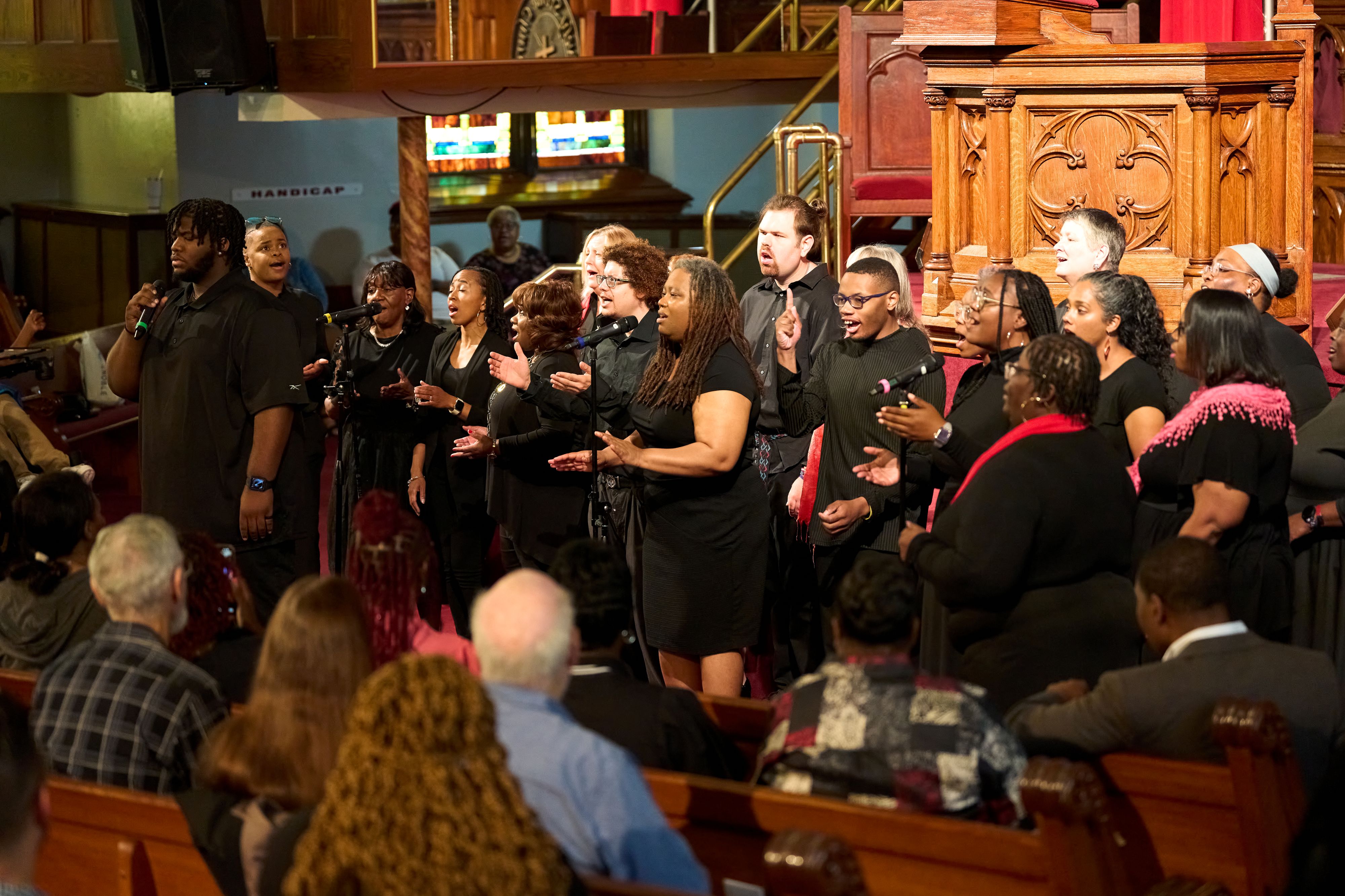
On any given day in any given city, people are gathering together to sing. Some arrive energized; others slip in quietly, carrying stress, loneliness, or fatigue. But within minutes, they are breathing together in rhythm, listening for one another, and contributing to a collective sound.
For decades, choruses have described these gatherings in artistic terms. Increasingly, however, another language is entering the conversation: wellness.
Across the U.S. and Canada and modeled after programs in places like the U.K., healthcare providers are beginning to recognize what many singers and chorus leaders have long seen in their ensembles: Participation in creative and community activities can play a meaningful role in well-being. The practice of formally connecting people to these activities through healthcare referrals is known as social prescribing, and while the terminology may be new to many arts organizations, the underlying idea is not. At its core is the simple recognition that humans regulate and restore themselves in relationship with other humans, often through shared creative experiences.
For chorus leaders, this shift doesn’t necessarily mean becoming clinicians or launching entirely new programs. In many cases, it means that the weekly rehearsal—the breathing together, the laughter between warm-ups, the accountability of showing up—is already doing more than making music. It is, in a very real sense, a form of care.
While there is no centralized definition of social prescribing, the generally understood concept is that it is the practice of referring patients to non-medical community activities to support well-being. These referrals can be made by healthcare professionals, or by non-clinical professionals known as link workers who connect individuals with local experiences that suit their needs.
"Social prescribing is not only the activity itself,” says Adrienne Hundley, head of community strategy at SocialRx, a social prescribing organization based in Atlanta and founded in 2022. “It’s the mechanism and infrastructure that allows for this connection to happen, and the power of the prescription that gives patients permission to allocate time for these activities.”
Using the term social prescribing to describe this process adds another step of validation, agrees Dr. Arla Good, lead researcher and co-director of SingWell, a research network based out of Toronto Metropolitan University that is studying the communication benefits of group singing. “It’s happening on sort of a grassroots level, and we see doctors who are already referring their clients to singing groups, and that people are accessing it through their primary care physicians as a referral. And calling it social prescription validates that pathway.”
While the infrastructure for social prescribing may still be in its early stages in the U.S. and Canada, it’s hardly a new phenomenon. In the United Kingdom, widely regarded as the first country to establish social prescribing within a national healthcare system, the practice dates back to grassroots community initiatives in the 1980s and 1990s and rose to prominence in the mid-2010s.
“Throughout England, you would be able to track down a link worker if you wanted to have a conversation about how you were feeling, or a doctor would be able to refer you to a local link,” says Baz Chapman, network manager for the Singing for Health Network in the U.K. “Doctors now are so aware of the value of personalized care, and there’s a change in mindset now that things like singing and a whole range of other things that social prescribing covers are really valuable.”
Social prescribing can be the referral of all sorts of activities—gardening groups, hikes, museum or zoo trips—but choruses are particularly strong partners due to the combination of social connection, routine, and creativity that these groups offer.
“Singing is more rapid social bonding compared to other groups,” says Good. “On day one, you’re going to feel more connected in a singing session than you are in an art session for example. It’s the icebreaker effect, and singing offers this advantage right out the gate. Once people have been showing up week after week, we see this boost in mood. Even when they walk in the room, we see a boost in mood and social connectedness.”
“If you’re thinking from the perspective of psychologically what we need in order to feel well and have a sense of hope and energy in our lives, [singing] provides a lot of that,” says Dr. Tasha Golden, a behavioral scientist and leading expert in creativity’s role in well-being and innovation. “It provides a sense of, ‘I have something that’s making me think about the future,’ which could be ideal for a lot of people.”
These benefits are reflected in broader research on arts engagement and well-being. According to Americans for the Arts, “Studies during the [COVID-19] pandemic found that just 30 minutes a day of arts engagement was associated with lower levels of anxiety and depression and higher rates of life satisfaction. And 75% of Americans say if their doctor prescribed arts participation to improve their health, they would do it.” For choruses, that openness indicates that social prescribing may not only affirm what leaders already observe in their rehearsal rooms; it may also invite participation from individuals who might not otherwise have considered joining a singing group.
For choral leaders, engaging with social prescribing is less about launching new programs and initiatives and more about naming what already exists: Choruses are spaces that promote quality of life for their participants.
“In my work, I’ve come to define well-being as having a life you want to participate in and feeling like you can,” says Golden. So, for choral leaders, “the work that you already do is having well-being benefits for the people who are in it. [. . .] It can be incredibly simple. You don’t have to change anything about what you do.”
Choruses can be social anchors, confidence builders, and spaces for emotional regulation. What’s more, they’re already providing health benefits for their singers, regardless of how those singers came to join. “There are plenty of people who sing in choruses who are not in perfect health,” says Chapman. “There are all kinds of things that we deal with in our lives. And one of the joys of choral singing is that it’s our way to escape or just to have something really mindful to do that makes us feel good.”
So what do choral leaders need to do differently when participants come through a social prescribing pathway? “Nothing,” says Good. “And that’s what’s so beautiful. The benefits are a byproduct of singing. You’re going to show up week after week, and you’re going to see these benefits. There’s no difference if the patient or client is coming to you from a social prescription pathway.”
One of the aspects of social prescribing that makes it so effective is also one of its biggest challenges: The prescriptions are highly individualized based on what the patient needs and what is accessible to them. To be successful, link workers need to have a thorough understanding of the organizations in their communities that can support social prescribing.
“I think it’s interesting for a lot of arts organizations to hear that I have met very little to no skepticism in this work from the healthcare provider side,” says Golden. “Part of what we’ve seen providers be most positive about with this work is that ‘I feel like my toolkit has expanded because now I have ways to address the things that I had no way to address before.’”
For chorus leaders, this openness from providers does not translate into a request for clinical credentials or formal therapy training. Instead, social prescribers are looking for partners with qualities that many ensembles already prioritize: reliability in rehearsal schedules, clear communication about expectations, and environments where participants feel welcomed.
“There is research that shows that [the benefit] is the creative engagement over time,” says Hundley. “Multiple engagements over time create the most impact, build up the most resilience, and show the most sustained elevation in well-being.” But rehearsals aren't the only good options for social prescribing. “On the receptive side where somebody gets to go and experience and appreciate the music, those [choruses] would be great partners as receptive experiences.”
Taken together, these insights show that many choruses already have what providers are looking for. “We know the benefits of singing, and communicating those benefits already makes us a great partner in this work,” says Good.
Chapman adds, "It’s important to package that in a way that a social prescriber might think, ‘Oh, I understand why this could be valuable.’” Whether a chorus is a small, open, community group or an auditioned symphony chorus, Chapman encourages choral professionals to consider who they could support. “Making sure that you know what kind of person you might be able to take on and how well you could support them is really important.”
Strong social prescribing partnerships are not about how a single chorus can be everything to everyone, but how choruses can be part of a network of singing groups and artistic experiences providing support for all kinds of patients, says Golden. “If a healthcare provider or social worker came to us [with a patient], we could say ‘Maybe they wouldn’t be a great fit for this group, but we have expanded our network and we know who they could fit with,’” she says. “That could be amazing—how we together could create a menu of opportunities for diverse people in our community.”
Across the U.S. and Canada, those who work in the social prescribing field are noticing more buzz on both the healthcare and artistic sides. “We are at a very critical moment where things can actually change,” says Dr. Alan Siegel, executive director and co-founder of Social Prescribing USA. “Things are rough in many areas between the mental health crisis, our healthcare crisis, our aging crisis. We should take the opportunity now to move things into action. It just seems like the right time to actually move social prescribing forward.” For many choruses, however, the question is: How do I actually begin?
Start internally. The first step often has little to do with healthcare infrastructure. “Talk with your participants and ask them what they think they get out of this,” says Golden. “You’ll start to hear how much that has to do with well-being. [. . .] Having that conversation and getting that feedback can be a really beautiful way to make sure that it's not a top-down sort of thing, but that you're allowing the whole group to co-envision what this is and could be with the community.” In some ensembles, that dialogue also reveals singers who are eager to explore next steps.
Clarify your why. Before reaching outward, many experts recommend aligning internally on purpose and capacity. Chapman encourages leaders to ask simple but grounding questions: “Why are you doing it? Is it because you want to be able to help people who are struggling in your community? Is it because you want to grow and diversify your membership? Is it something that the whole choir believes in? In order to really make it work, to have those really transformational benefits, there needs to be a degree of consensus.” Just as important is recognizing boundaries: considering what kinds of needs or conditions a group realistically feels equipped to support and understanding that not every referral or opportunity will be the right fit.
Share the load. Social prescribing does not need to be a solo endeavor. In fact, many choruses discover that their own members already hold valuable community connections—sometimes including doctors, nurses, therapists, public health professionals, or others working in healthcare systems. According to Chapman, simply asking, “Who’s got links? Who might be willing to open a door or sit down and work some of this through?” can distribute responsibility and reduce pressure on the conductor or artistic director. Leaders do not have to write every policy or make every call; often, they can allow the wider membership to participate in shaping the effort, drawing on the expertise that may already be in the room.
Reach out locally. When ensembles do begin connecting externally, the most effective entry points are often close to home. “If you know a local doctor’s office or health clinic and create a relationship,” says Hundley, “it can become a kind of grassroots social prescribing initiative” that grows organically rather than through large institutional structures. “It's through partnerships that these things can get off the ground. And then it's through the advocacy work that they sustain,” Good adds. “There’s bottom-up work that needs to be done, and there's top-down work that needs to be done. Bottom-up work is messy, it's cold calling, it's building partnerships, it's applying for grants, and it's getting singing groups off the ground. Top-down is the advocacy work that will hopefully make pathways a little smoother.”
Address funding and sustainability. Early steps often cost far less than leaders expect. “You can start small,” Chapman says. “You can have a conversation with a link worker and just get one person to come and try it out.” Golden adds, “The first thing you can do is recognize yourself as a place where this can start,” rather than assuming large grants or formal systems must be in place from day one. As partnerships grow, additional support may follow. Golden notes that “there are funding streams that become available to organizations that do this explicitly and with intention,” particularly when ensembles can articulate and evaluate the well-being impacts they already see.
Social prescribing does not ask choruses to transform into clinics or to carry the weight of healthcare systems on their shoulders. At its heart, it simply recognizes what chorus leaders and singers have long understood: Gathering to make music together can be a meaningful part of how people care for themselves and one another.
For many ensembles, participating in this movement will be about keeping the door open and trusting that the act of singing together already holds value. The invitation is to recognize that what is already happening each week is contributing to something larger: a community where music is felt as a shared source of belonging and care.
For more info on this topic check out our resource list on social prescribing.
Kaeli Todd is a freelance writer and editor based in Tacoma, Washington. After singing in choruses throughout high school and undergrad and a career in nonprofit fundraising, she found her way back to the choral field as the managing editor for The Voice. Contact Kaeli at [email protected].