Image

| Registration Type | Member Price |
|---|---|
| Early Bird Registration (Sept. 11-Oct.3) | $750 |
| General Registration (Oct. 4-Oct.17) | $850 |
| Registration Type | Member Price | Non-Member Price |
|---|---|---|
| Early Bird Registration (Sept. 11-Oct. 3) | $750 | $850 |
| General Registration (Oct. 4-Oct.17) | $850 | $950 |
Not a member? We'd love to have you join us for this event and become part of the Chorus America community! Visit our membership page to learn more, and feel free to contact us with any questions at [email protected].
| Registration Type | Non-Member Price |
|---|---|
| Early Bird Registration (Sept. 11-Oct. 3) | $850 |
| General Registration (Oct. 4-Oct.17) | $950 |
Think you should be logged in to a member account? Make sure the email address you used to login is the same as what appears on your membership information. Have questions? Email us at [email protected].
| Registration Type | Price |
|---|---|
| Individual Session | $30 each |
| All Four (4) Sessions | $110 |
*Replays with captioning will remain available for registrants to watch until November 1, 11:59pm EDT.
Member Professional Development Days are specially designed for Chorus America members. If you're not currently a member, we'd love to welcome you to this event, and into the Chorus America community! Visit our membership page to learn more about becoming a member of Chorus America, and please don't hesitate to reach out to us with any questions at [email protected].
| Registration Type | Price |
|---|---|
| Individual Session | $30 each |
| All Four (4) Sessions | $110 |
*Replays with captioning will remain available for registrants to watch until November 1, 11:59pm EDT.
| Registration Type | Price |
|---|---|
| Individual Session | $30 each |
| All Four (4) Sessions | $110 |
*Replays with captioning will remain available for registrants to watch until November 1, 11:59pm EDT.
Member Professional Development Days are specially designed for Chorus America members. If you're not currently a member, we'd love to welcome you to this event, and into the Chorus America community! Visit our membership page to learn more about becoming a member of Chorus America, and please don't hesitate to reach out to us with any questions at [email protected].

Genuine community in a choral ensemble doesn’t happen by accident. Here are some practical tools to build it deliberately, so your chorus is ready when tension arises.
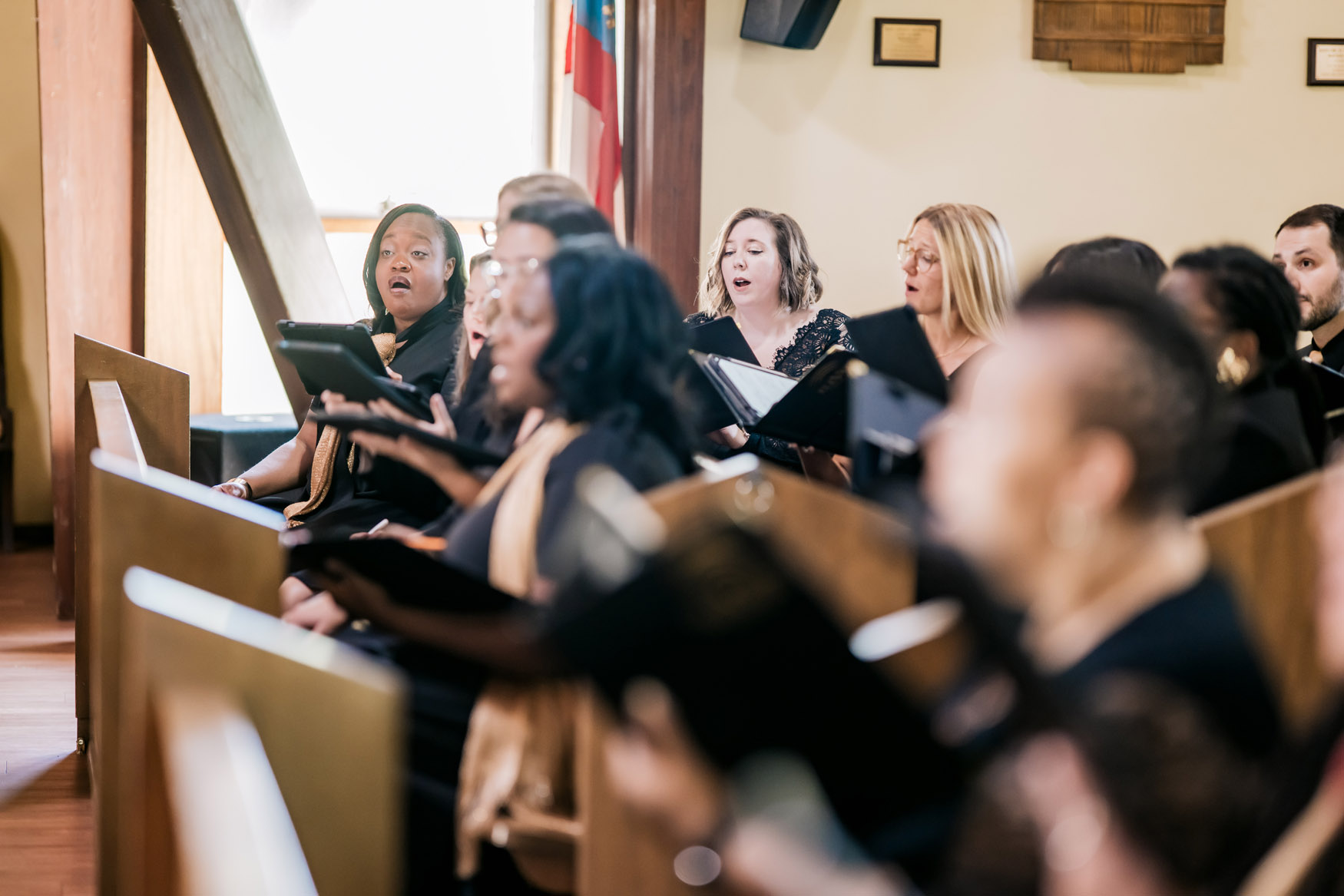
Maybe as a conductor you’ve seen it. A shift in the rehearsal atmosphere. Silence where there once was easy conversation and laughter. Averted eyes where there once was engagement.
Maybe as a singer you’ve felt it. A hesitation to open up to your section. A sense of being out of step with the group. Something you want to say—about the repertoire, about the direction things are heading, about something happening in the world outside the rehearsal room—but no idea whether anyone else feels the same way.
"When we bottle up these things and ignore the stuff that we really should be talking about, it just allows it to stew and to settle," says Brittney Stanton, interim executive director of Elevate Vocal Arts. "At some point, a straw is going to break."
Choral ensembles are unusually well-suited spaces for human connection, but that environment doesn’t happen without effort. When tension goes unaddressed, it often compounds rather than dissolving. The question isn’t whether your ensemble will ever face a moment of disconnection or conflict, it’s whether you’ll have the tools to meet it.
When many choral leaders think of division in their ensembles, they likely picture something dramatic, like someone leaving in the middle of rehearsal. But Stanton says the more common form of disconnection is quieter.
"The bigger part is the things that don't get said," Stanton says. "You can't necessarily tell when those are happening until there is some kind of volcanic moment."
Jazmin Salaberrios, lead faculty with Elevate Vocal Arts, describes it in terms conductors will immediately recognize. Every ensemble has its own rhythm of engagement, like the way singers lean in, make eye contact, or respond to each other. When that energy starts to dim, Salaberrios says it’s worth paying attention: "If you're looking out into your group and you see that moment when everyone should be extremely engaged because of your group's usual habit, then you should be suspicious of what's going on," she says. “As musicians, we are all very sensitive due to what music does to us neurologically, so you can sense and feel that in the atmosphere.”
Other signs to look for include talkative people going quiet, singers leaving without interacting with anyone, and a reluctance to take risks in music-making
Division in an ensemble can arise from any source of friction: disagreements over repertoire direction, resistance to organizational change, generational differences in communication styles, or cultural growing pains as an ensemble diversifies.
This is exactly why the best time to build a culture of open dialogue in your ensemble is before the bigger issues arise.
It’s understandable that conductors would be reluctant to address tension, especially when it feels like the stakes are low. The ensemble exists to make music, and anything that takes away from that may feel like a sacrifice of time and energy. There's a concert to prepare or repertoire to learn. The clock is always running.
But Stanton offers a reframe: Addressing disconnection is an integral part of musical preparation. "It's going to make us better humans, it's going to make us a better ensemble, and ultimately it'll make the learning process of repertoire and concert preparation faster," she says.
The same holds for adults. Stanton points to the mindfulness practices she implemented at the Choir School of Delaware, an intergenerational ensemble ranging from singers as young as seven to adults in their seventies. Across the ensemble, creating intentional space for non-musical connection changed the quality of the musical work. “Sometimes folks get into this place of, well, it has to be all about the concert [. . .] but if we’re not making space within our time together, you’re missing out on an opportunity to build community, which ultimately makes the music better,” she says.
But when ensembles do nothing, tension compounds. This is why Stanton emphasizes the importance of building these practices before a crisis. “It needs some scaffolding,” she says. “It takes time, it takes practice, it takes repetition—just like the music we’re putting on.” The facilitation tools in this article work best as habits introduced in low-stakes moments, so they become a familiar part of rehearsal culture.
Before introducing tools to your ensemble, it’s important to establish the kind of environment that those tools require.
Most conductors are familiar with the idea of creating a "safe space" in their ensembles: a place where singers feel comfortable, respected, and free from judgment. But researchers Brian Arao and Kristi Clemens argue that safety, as it's commonly understood, can actually work against the deeper goal of genuine community.
In their 2013 chapter "From Safe Spaces to Brave Spaces," Arao and Clemens point out that expecting difficult conversations to feel "safe"—meaning comfortable and unthreatening—can inadvertently center the experiences of those who have the luxury of feeling comfortable. Promising safety can mean, in practice, protecting people from the productive discomfort that genuine dialogue requires.
Their alternative is something called the brave space. A brave space doesn't promise comfort. It's an environment where everyone agrees, in advance, that the conversation may be hard, and that they will approach that difficulty with courage and openness rather than avoidance.
"We're acknowledging it, we're giving it space to breathe, and we're working to address it,” Stanton explains. “And it takes bravery to do those things, especially when we're faced with tension or difficult topics."
In a safe space, the common ground rule is "don't take it personally." In a brave space, that becomes "own your intentions and your impact," which is an acknowledgment that good intentions don't always prevent harm, and that conflict will be navigated with respect and a genuine effort toward understanding.
For conductors, the shift from safe to brave space happens when you set the culture for it in your ensemble. If you avoid difficult topics, your ensemble learns that difficult topics are avoided here. If you engage in them with structure, care, and courage, your ensemble learns that too.
Once the environmental groundwork happens, there's a specific facilitation method Stanton and Salaberrios have found particularly well-suited to choral contexts: The Circle Protocol, drawn from the broader field of restorative practices.
According to Mediators Beyond Borders International (MBBI), circle processes have deep roots: “Circles are considered to be one of the oldest forms of group process. Indigenous and first peoples cultures from around the world used and continue to use circle processes to facilitate community conversations about important subjects.” In more recent decades, the approach has been formalized and adapted for use in schools, workplaces, and communities, most notably in restorative justice settings, where it was developed as a way to repair relationships after harm.
"It allows everybody an opportunity to speak whatever is on their mind, on their hearts, in a way that is safe," Stanton says. "It creates this place where you have the opportunity to voluntarily offer whatever you want to say, but in a way that ensures that you have the floor and other folks will allow you to have the floor."
She acknowledges that the structure can feel juvenile at first; passing an object around a room full of adults is not how most professional environments operate. But that's part of the point. "I think even in staff meetings, we might be talking over each other," she says. "It allows that openness for people to be able to speak their minds without being talked over."
A circle keeper, like the conductor or a trusted ensemble leader, might open by naming what’s present without taking sides: We’ve just received some significant news, and I imagine people are sitting with a lot of different feelings about it. I want to make space for that before we get into the music this evening. The talking piece begins its first round with an opening question: What word or phrase captures what you’re carrying into the room today?
A second round goes deeper: What does this ensemble mean to you, and what do you hope stays true about it? This question redirects attention from the change itself toward shared values among singers who may be reacting differently. By the time the circle reaches its closing question—What do you need from each other as we move through this transition together?—the room has shifted because people have spoken honestly and been listened to.
One critical point Stanton emphasizes: Circle Protocol is not a band-aid. It won't resolve a years-long conflict in a single rehearsal. And sometimes resolution isn't fully achievable, but forward movement is. "Sometimes we have to accept not actually getting resolved," Stanton says. "But that doesn't mean the work changes. We can keep working towards it."
Salaberrios adds: "You can't change people's minds. But you can help them change their habits, and in return their habits will affect their thinking."
Here are several activities, both musical and non-musical, for building genuine connection within an ensemble.
Mindfulness Exercises
One of the most consistent practices Stanton has used is opening rehearsals with a few minutes of mindfulness: breathing exercises or simple centering activities that help singers ground themselves in the space.
"It's about centering ourselves so that we are in a clear mental space to move forward with our tasks," Stanton says. These practices tie into social-emotional learning, a framework more commonly discussed in K–12 education, but one Stanton argues adults need just as much. “We might need it more some days,” she notes.
Playfulness
Gameplay—a rock-paper-scissors tournament, an ensemble bingo card where singers find someone who loves to cook or played a sport in college—creates low-stakes reasons for people to talk to peers they don’t usually engage with. Salaberrios takes the structure a step further with a three-phase “Would You Rather” activity: Singers move to opposite sides of the room based on their answer, find someone who agrees and discuss why, then find someone who disagrees and do the same.
The game format creates an easy on-ramp to genuine cross-ensemble connection. "Don't be like, oh, we're too old for that," Stanton says. "It's relevant no matter what age you are."
Connect Activities to the Music
Non-musical doesn't have to mean disconnected from the ensemble's artistic work. When Stanton's ensemble performed at the ACDA Eastern Division, they made protest signs connected to the repertoire. "It can still be connected to what your musical goals are, even if it's not musical in nature," Stanton says. "Don't make it about the musical output, but rather the message or the intention or even the culture."
Beyond the activities above, Stanton offers a set of structured discussion prompts designed to be used within a circle format, adaptable for any age, any ensemble, and any level of tension. The prompts are organized by purpose, so conductors can choose based on what the room needs that day.
Check in circles can be used at the top of rehearsal to bring people into the room and create presence before musical work begins. Try the Weather Report: If your emotional state right now were a weather pattern, what would it be?
Community-building circles deepen relational connection over time. Try the Origin Story: Tell us about the person or moment that first made music feel like it belonged to you.
Restorative circles can help when something that has happened is present in the room and needs acknowledgment. Try What I Wish You Knew: Without naming anyone or taking sides, what's one thing you wish the people in this room understood about your experience right now?
Closing circles create intentional closure and carry the community feeling beyond the rehearsal. Try the Pass Forward: What's one thing you're going to carry from this rehearsal into the rest of your week?
What you need:
How it works: The circle keeper opens by naming the topic and establishing norms. The talking piece is passed around; only the person holding it speaks. Everyone else listens. Multiple rounds of questions guide the conversation from check-in through the topic and toward closure.
Sample questions for choral ensembles:
Time commitment: Can be as brief as 10–15 minutes for a single-question check-in, or extended to a full conversation as needed. Set parameters in advance and stick to them.
When to use it: Ideally as a regular, low-stakes practice that becomes familiar and safe. Also useful for processing a difficult moment, debriefing after a significant performance, or navigating a decision that affects the whole ensemble.
Research has shown that singers join ensembles for connection—people who sing in choruses report stronger social bonds and more meaningful friendships. “We are all coming to these ensemble experiences because we all want the same thing,” notes Stanton.
The facilitation techniques outlined in this article are about what happens next: how conductors and ensemble leaders turn that shared desire into an environment that’s sturdy enough to hold when tensions rise. And this requires deliberate, ongoing work.
"It's more than just a check-in," Stanton says. "It's more than just saying, ‘All right, how are you feeling today?’ It's going deeper."
Going deeper means introducing circle prompts before you need them, naming ensemble norms at the start of the season, and building the rehearsal habit of genuine, brave presence. The ensemble that does this work can increase connection and improve music-making, but it also creates a community where people feel genuinely known. In a cultural moment when that kind of belonging is increasingly rare, it may be one of the most important things a chorus can offer... and it can start at your next rehearsal.
Kaeli Todd is managing editor of The Voice and a freelance writer and editor with over a decade of experience in in nonprofit storytelling, marketing, and fundraising communications. A lifelong singer, her personal connection to choral music informs her professional passion for supporting creative communities and amplifying the voices of organizations that strengthen connection and belonging through the arts. Contact Kaeli at [email protected].