Image

| Registration Type | Member Price |
|---|---|
| Early Bird Registration (Sept. 11-Oct.3) | $750 |
| General Registration (Oct. 4-Oct.17) | $850 |
| Registration Type | Member Price | Non-Member Price |
|---|---|---|
| Early Bird Registration (Sept. 11-Oct. 3) | $750 | $850 |
| General Registration (Oct. 4-Oct.17) | $850 | $950 |
Not a member? We'd love to have you join us for this event and become part of the Chorus America community! Visit our membership page to learn more, and feel free to contact us with any questions at [email protected].
| Registration Type | Non-Member Price |
|---|---|
| Early Bird Registration (Sept. 11-Oct. 3) | $850 |
| General Registration (Oct. 4-Oct.17) | $950 |
Think you should be logged in to a member account? Make sure the email address you used to login is the same as what appears on your membership information. Have questions? Email us at [email protected].
| Registration Type | Price |
|---|---|
| Individual Session | $30 each |
| All Four (4) Sessions | $110 |
*Replays with captioning will remain available for registrants to watch until November 1, 11:59pm EDT.
Member Professional Development Days are specially designed for Chorus America members. If you're not currently a member, we'd love to welcome you to this event, and into the Chorus America community! Visit our membership page to learn more about becoming a member of Chorus America, and please don't hesitate to reach out to us with any questions at [email protected].
| Registration Type | Price |
|---|---|
| Individual Session | $30 each |
| All Four (4) Sessions | $110 |
*Replays with captioning will remain available for registrants to watch until November 1, 11:59pm EDT.
| Registration Type | Price |
|---|---|
| Individual Session | $30 each |
| All Four (4) Sessions | $110 |
*Replays with captioning will remain available for registrants to watch until November 1, 11:59pm EDT.
Member Professional Development Days are specially designed for Chorus America members. If you're not currently a member, we'd love to welcome you to this event, and into the Chorus America community! Visit our membership page to learn more about becoming a member of Chorus America, and please don't hesitate to reach out to us with any questions at [email protected].

Opera America’s new president, Michael J. Bobbitt, on why advocacy is critical to reimagining the future of the arts sector
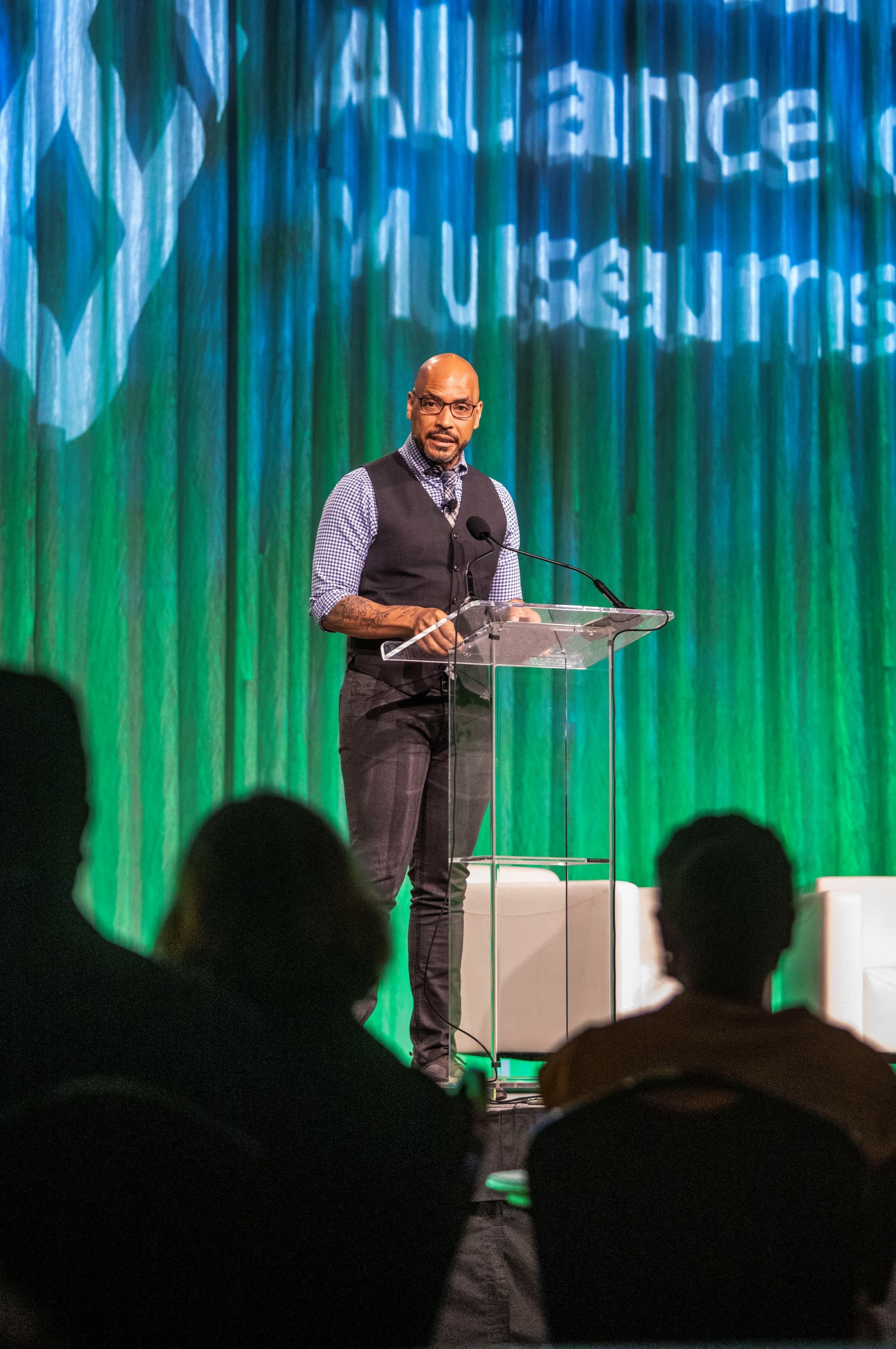
Michael J. Bobbitt brings a rare combination of organizational leadership, artistic and producing credentials, and hands-on advocacy experience to every room he enters. As the newly appointed president and CEO of Opera America, he arrives with a track record that includes leading the Massachusetts Cultural Council as executive director since 2021, and championing arts prescribing, arts and education, artist housing, and political advocacy at the state and national level.
Bobbitt will appear in conversation with Chorus America president and CEO Christopher Eanes at a plenary session at the 2026 Chorus America Conference. In advance of that session, the two spoke about the economic crisis facing the arts sector, why political advocacy must become a core competency for arts organizations of every size, and what it will take for the arts field to stop naming its problems and start solving them.
Christopher Eanes: You have a deep background as a performing artist, artistic director, and now arts leader at the national level. At what point did advocacy start to feel like a significant part of that work?
Michael Bobbitt: Early in my tenure running Adventure Theatre in Maryland, I skipped a legislative breakfast where public officials were discussing what they would do for the arts. Within minutes of the meeting starting, I got texts and emails from colleagues asking where I was. One of them told me to cancel whatever I was doing and get there immediately—that it was the most important room for me to be in. That message landed hard.
After that, I started paying attention to where the movers and players of the Montgomery County arts scene were spending their time. They were in chambers of commerce meetings, healthcare rooms, transportation rooms. Anywhere that affected the arts, those leaders were present. I realized that they were thriving because of the relationships they were building with government. So I started showing up too.
I joined the Arts and Humanities Council board for Montgomery County, testified at the Maryland Statehouse, and eventually joined the Maryland Citizens for the Arts board. What began as a light bulb moment deepened into something more fundamental. The more I got involved, the more I understood that advocacy isn’t just part of the job. It’s a core function of the job.
CE: Let's talk about that. You've said that there is nothing more important than advocacy for the arts sector, especially right now. And I think most people in our field would agree with that, but advocacy feels really abstract to many arts leaders. It slips down the priority list. How would you help people shift that mindset?
MB: Part of the challenge is that people conflate very different things under the word advocacy. There’s advocacy as a messaging campaign or an education campaign, as social justice—standing up for someone else’s oppression—and then there’s political advocacy. These are distinct, and none of them are really taught in arts degree programs or even in arts administration programs.
But if you look at sectors that are doing well—trucking, utilities, fossil fuels, environmental groups—they’re thriving in part because they’re excellent at political advocacy. If the arts are disorganized, uninformed, or treat advocacy as optional, it’s no surprise there’s so little cultural policy on the books at the federal or local level.
I think government can do three things: program, regulate, and finance. The arts sector almost exclusively thinks of government as a grantmaker, what I call “no strings attached” bailout money. We’re missing out on the other two things it can do entirely. If you cross-reference programming, regulation, and finance with workforce development, economic development, and placemaking, there are hundreds of things government could do for us.
Government responds to pressure from interest groups asking for specific things. It’s not enough to say that the arts are important. You need hundreds of thousands of people knocking on doors of decisionmakers and saying, “What are you going to do about these things that are problems for us?”
CE: In your experience, how important is data in making the case for arts advocacy?
MB: It depends on who you’re selling to. When we were building the arts prescribing program in Massachusetts, we needed data and research to make the case to healthcare partners. But sometimes advocacy is purely about political muscle—the sheer number of voters behind an issue. Legislators want to solve problems and help their constituents, and their currency is votes. So sometimes data helps, and sometimes it may not even be necessary.
Think about how much data exists on gun violence deaths. And yet, data alone doesn’t move policy. What moves policy is organized people making noise.
CE: What does it actually look like when a small organization—like a chorus with one part-time staffer and a volunteer board—treats advocacy as a core competency?
MB: Advocacy doesn’t require a full-time hire or dozens of hours a month. It requires one person who is designated and accountable. And that person needs to be reporting out regularly at staff meetings and at board meetings.
Here’s a small practical checklist of actions: Are your local, state, and federal legislators on your VIP list? Do you invite them to your openings? Are you giving them moments to be photographed with your organization and tagging them on social media? Are you meeting with them at least once a year to ask for what you need?
And are you communicating advocacy issues to your audience, to the people that are enjoying your work? If something is happening in government that could affect your organization, your community needs to know about it. Are you meeting with other arts organizations in your communities to see what commonalities exist that might require legislative intervention?
CE: What would you say to an organization that feels too small to matter to elected officials?
MB: They’re wrong. Full stop. You may have a small staff, but you may also have a large chorus, a large volunteer group, and a large audience. Those are all potential voters and constituents of decisionmakers. In Massachusetts, if a legislator hears from just four people on a specific topic, it has to be escalated to the next level. Four people. The bar is not as high as most arts people assume.
And if you can’t do it alone, join forces. If I can’t go to a town hall meeting, but you can, we can collect those notes in a shared drive. Then everyone can keep up with it.
CE: The choral field has more than 54 million Americans who sing in choruses. How do you activate that kind of constituency?
MB: It’s a little chicken-and-egg. Sometimes you find a compelling policy issue and use it to organize and mobilize people around a shared cause, then work to keep them engaged. Sometimes you start with education, just being direct with your community: “This is what we should be doing, here’s why, and here’s how we’re going to mobilize.” But the more advocacy becomes a regular practice and a core function of arts organizations, the easier it gets.
Think about the last presidential election. Artists were everywhere on both campaigns: Taylor Swift, Beyoncé, Kid Rock. The artists were being used to mobilize voters, but neither of the candidates had an arts platform. We were giving our power away without asking for anything in return. When was the last time you met a legislator who ran with an arts platform? If we’re not demanding it, if we’re not putting that pressure on candidates, it won’t happen.
CE: Can we leave it to candidates to develop their own arts platforms? Or should we give that arts platform to them?
MB: We give it to them just like every other industry does. Policies come from constituencies, interest groups, and lobbyists. That’s how the system works. Our job as a sector is to say: “Here is a problem affecting us that you may not even know about, and here is a proposed solution.” Legislators then take it through their process, and it may or may not make it through, but at least it’s on the docket. Then you can build on it, refine it, and socialize it.
CE: You’ve been direct about saying the funding that has traditionally supported the arts is not going to grow. What does the mindset shift away from dependency on traditional funding actually require?
MB: The first shift is from thinking about funding to thinking about financing. Most arts organizations have genuine earned revenue potential, but we go into this work assuming everything has to be subsidized. So that’s a big mindset shift that requires people to learn more solid business acumen. I was recently talking with a friend who’s building an artist service organization. Every conversation was about funding, funding, funding. I had to stop her and say, “This could be a business where people pay for a service.”
The second shift is understanding that when government prioritizes certain things, the private sector follows. When the previous administration prioritized DEI, you saw businesses, philanthropy, and nonprofits all following that signal. When the current administration reversed course, those resources evaporated. The arts are experiencing the same dynamic right now. SMU DataArts recently reported a 25 percent decline in average revenue for arts organizations[LB1] . Philanthropy is moving away. Private consumption is changing. That’s another reason why advocacy has to become essential—so that the arts become a government priority, and private capital should follow.
In opera, we’ve reduced supply by 50 percent over the last 25 years while costs have doubled. Philanthropy can’t keep covering the gap indefinitely.
CE: Where else should arts organizations be looking for revenue beyond traditional philanthropy and ticket sales?
MB: From sectors where the arts already produce measurable outcomes. In Massachusetts, we ran an arts prescribing program where healthcare was paying the arts for people to attend arts events—not because we asked them for money, but because we were helping healthcare do its job of making people healthier. Typically, we go to healthcare, tell them that the arts are good for health, and then raise money ourselves to do healthcare’s work. We need to flip that. If kids who participate in arts education demonstrably perform better academically, then the education sector should be paying us for that work.
There are examples everywhere once you start looking. I introduced the former Massachusetts Secretary of Transportation to traffic calming art. Muralists painted intersections at spots where people were routinely getting hit by cars but where the volume of cars crossing those intersections didn’t meet the threshold for a stop sign or traffic light. The research shows that those traffic calming murals slow traffic by 50 percent.
The key is to stop siloing ourselves. Get into rooms that aren’t arts rooms. Start seeing people in other sectors as potential clients and consumers. A mentor of mine once told me that “people do business with people they know.” So I started showing up at Chamber of Commerce meetings, joining economic development boards, building relationships with people I wouldn’t normally encounter. Those connections became sponsors, donors, board members, vendors, partners, and audience members.
CE: What specifically do you mean when you say the arts sector needs more business acumen? Arts leaders often bristle at the saying “Run it like a business.”
MB: What I mean by business acumen is understanding microeconomics, supply and demand, consumer behavior, competitive strategy, customer behavior, pricing, innovation, entrepreneurship, data analysis, product-market fit, growth strategy, negotiation, change management, etc. It means learning how to build something people would pay for and designing your organization around covering expenses with primarily earned revenue, with philanthropy playing a supporting, rather than life-support, role. Business, at its core, is mission-based: You identify a problem, develop a solution, and try to make money from that solution.
I don’t see it as bad. Companies are trying to develop products that make the world better and easier for people. And the ones that succeed are the ones that actually make it better and easier for people. Solid business acumen amplifies the art; it doesn’t erode it.
CE: Given the cuts to arts funding, declining trust in institutions, and pressure on community organizations right now, how does that change what advocacy needs to look like today compared to five years ago?
MB: Honestly, I see it as an opportunity. This moment is an invitation to step out of our echo chambers and demonstrate that the arts can help solve the very problems that are dominating public conversation: housing, workforce, public health, transportation, education. But seizing that opportunity requires closing skills gaps, de-siloing, innovating, and showing up in spaces we’ve historically avoided.
When I was in Massachusetts and the housing crisis was consuming every policy conversation, I started showing up in housing meetings. The Secretary of Housing actually stopped me once and said, “Michael, what are you doing here?” I said, “Artists live in houses.” He laughed, but the point landed. And as I looked around those rooms, I realized I was the only person from the arts sector there. Meanwhile, arts organizations were telling me constantly about their housing problems. I kept asking, “Why weren’t you in the room where this was being discussed?”
If no one from the arts is there, the assumption is that the arts sector doesn’t have a housing problem. We need to start showing up.
CE: Where do you hope to see the arts sector in a decade?
MB: We’re good at naming problems, but now we have to get really good at solving problems.
What inspires me is that we are creatives. We can take a blank sheet of paper and see things on it that other people can’t. We can look at our industry that’s struggling financially and envision a version of it that thrives. If libraries could reinvent themselves into the vibrant community anchors they’ve become, we can reinvent ourselves too. If baseball, a major American pastime, can look at declining engagement and honestly ask what needs to change, we can do the same.
But it’s going to require real change. And a willingness to be, as I like to say, bad at some things in order to be great at the things that matter most. Only the arts can fix the problems that exist in the arts. My question to everyone involved in Chorus America is: What side of history do you want to be on? The side that evolved or the side that perpetuates the problems that erode us?