Image

| Registration Type | Member Price |
|---|---|
| Early Bird Registration (Sept. 11-Oct.3) | $750 |
| General Registration (Oct. 4-Oct.17) | $850 |
| Registration Type | Member Price | Non-Member Price |
|---|---|---|
| Early Bird Registration (Sept. 11-Oct. 3) | $750 | $850 |
| General Registration (Oct. 4-Oct.17) | $850 | $950 |
Not a member? We'd love to have you join us for this event and become part of the Chorus America community! Visit our membership page to learn more, and feel free to contact us with any questions at [email protected].
| Registration Type | Non-Member Price |
|---|---|
| Early Bird Registration (Sept. 11-Oct. 3) | $850 |
| General Registration (Oct. 4-Oct.17) | $950 |
Think you should be logged in to a member account? Make sure the email address you used to login is the same as what appears on your membership information. Have questions? Email us at [email protected].
| Registration Type | Price |
|---|---|
| Individual Session | $30 each |
| All Four (4) Sessions | $110 |
*Replays with captioning will remain available for registrants to watch until November 1, 11:59pm EDT.
Member Professional Development Days are specially designed for Chorus America members. If you're not currently a member, we'd love to welcome you to this event, and into the Chorus America community! Visit our membership page to learn more about becoming a member of Chorus America, and please don't hesitate to reach out to us with any questions at [email protected].
| Registration Type | Price |
|---|---|
| Individual Session | $30 each |
| All Four (4) Sessions | $110 |
*Replays with captioning will remain available for registrants to watch until November 1, 11:59pm EDT.
| Registration Type | Price |
|---|---|
| Individual Session | $30 each |
| All Four (4) Sessions | $110 |
*Replays with captioning will remain available for registrants to watch until November 1, 11:59pm EDT.
Member Professional Development Days are specially designed for Chorus America members. If you're not currently a member, we'd love to welcome you to this event, and into the Chorus America community! Visit our membership page to learn more about becoming a member of Chorus America, and please don't hesitate to reach out to us with any questions at [email protected].

How Te Deum unlocked a new level of donor support by crafting a compelling case for transformational change
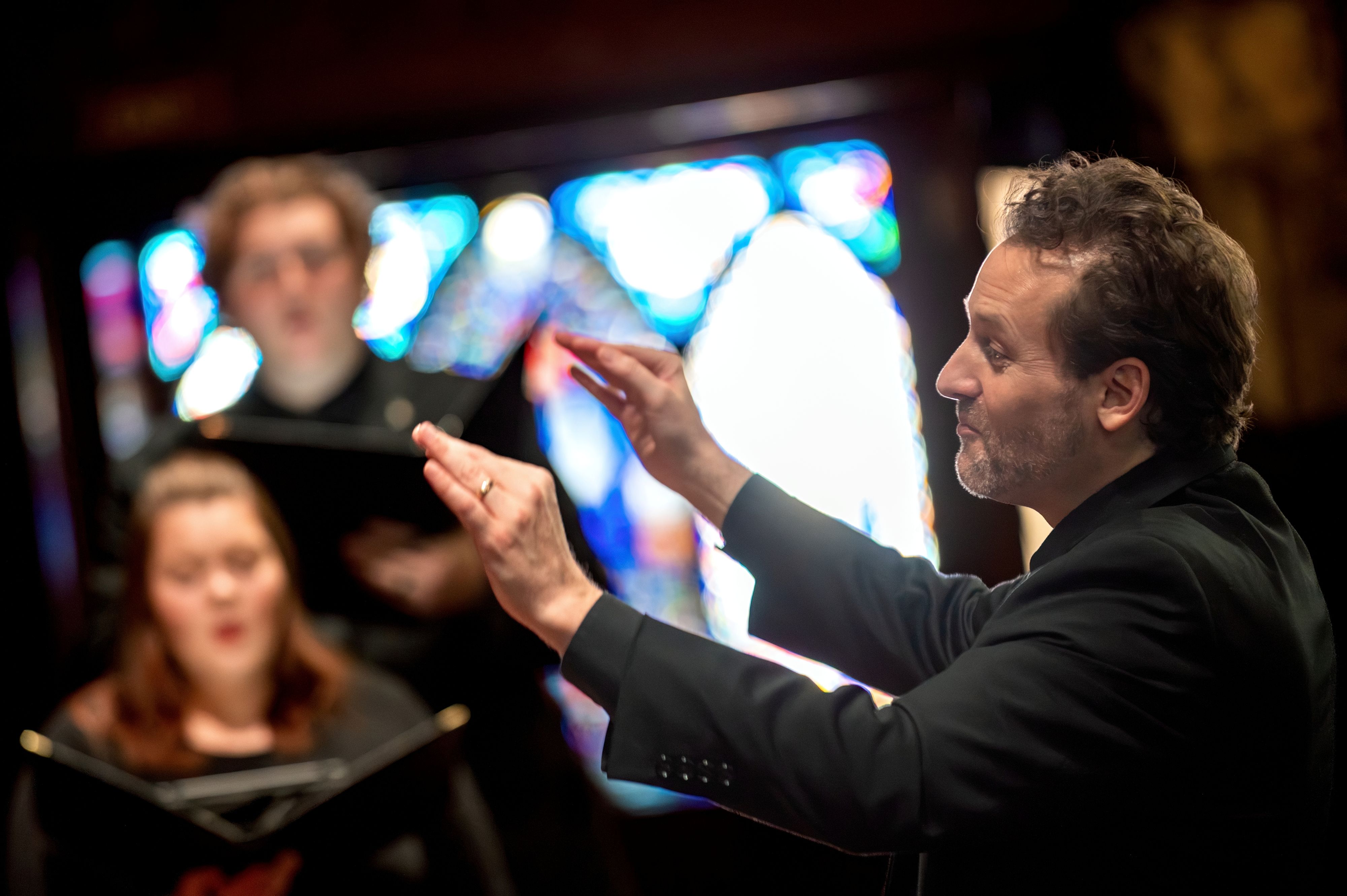
SPONSORED STORY FROM A CHORUS AMERICA PARTNER
After cultivating a rigorous and dedicated volunteer ensemble in Kansas City for 15 years, Te Deum founder and artistic director Matthew Shepard embarked on a transition to an all-professional model – one that he’d resisted several times before. To his surprise, Shepard and his colleagues found that this process, which felt so daunting before, was not only achievable; it helped the organization find another gear.
“Don’t underestimate the power of a well-articulated vision,” advises Shepard, recalling the planning that allowed Te Deum’s shift to become reality. “Once we were able to clearly communicate our goals, fundraising became far more effective, and people wanted to be part of what we were building.”
While the message is simple, Te Deum’s journey to get there is the result of careful planning. We talked with Shepard to learn more about what steps the organization took to develop this vision, how they moved forward once their goals were outlined, and what they learned along the way.
Te Deum began in early 2008, after overwhelming encouragement from singers, conductors, and musicians in Kansas City who expressed a desire for a new, high-caliber choral ensemble. After taking a careful look at the local landscape and speaking with a number of colleagues and stakeholders, we discovered a shared sense that our community needed an ensemble devoted to sacred music at the highest level.
From the beginning I believed deeply in the vision and wanted to build something that could last. So rather than starting with auditions, we focused first on infrastructure. We developed a business plan and began recruiting a board of directors, making sure the organization had a strong foundation before a single note was sung. Once that was in place, we worked through the early legal steps (bylaws, incorporation, and 501(c)(3) status) and held auditions later that year. Our first concert followed soon after in the Spring of 2009.
In those early years, Te Deum was a volunteer ensemble with high expectations. Many of our singers were professional musicians who gave their time because they believed in what we were building. They were drawn to the repertoire, but also to the kind of artistic experience we were trying to create. Growth was gradual, but steady. We presented two concert cycles each year, used a donation-based ticket model, and performed for audiences that were, at first, largely made up of friends and early supporters.
An early turning point came in 2013, when we recognized another gap in the community: a choral ensemble dedicated to historically informed early music. That led to the launch of our “Antiqua” series, which focused on chant and early repertoire from the medieval, Renaissance, and Baroque periods. After a few seasons, Antiqua and the main ensemble merged into a single identity, allowing us to expand to four concert cycles each year while keeping early music as one of our core offerings. We continued like this for the next ten years.
We spent our first 15 seasons as a volunteer ensemble. During that time, we often discussed compensating singers, but ultimately chose not to. We were able to fulfill our mission of offering transformative sacred music at a high level without the financial strain of a professional model. Our singers were deeply committed, the budget remained manageable, and the risk of making that shift felt difficult to justify without a clear return.
That calculus changed after 2020. In the wake of the pandemic, many people became more protective of their time, and the pool of interested volunteer singers with the necessary skill began to shrink. At the same time, the choral landscape in Kansas City grew more competitive, with new ensembles emerging, several of which offered compensation. We continued to perform well and grow, but it became noticeably more challenging to attract and retain the level of artist we needed. We kept on this way for a few more years, but it was clearly unsustainable.
In 2023 we undertook a major strategic planning process. It began with a deeper articulation of our artistic vision and a candid assessment of our long-term goals. I also sought outside perspective through a business development workshop, which helped clarify what it would take to expand our impact.
What emerged was a more ambitious vision for Te Deum to have a broader influence in Kansas City and a stronger presence regionally and nationally. Once that vision was clear, the path forward was as well. Transitioning to a professional ensemble was no longer a question of if, but of when. It became one of the most essential steps in aligning our artistic aspirations with the structure needed to sustain them.
Clarifying the strategic plan was the essential first step. The board and I spent nearly a year working through our three-, five-, and ten-year goals, making sure the vision was both ambitious and actionable.
At the same time, I had one-on-one conversations with each of our singers. I wanted to understand not only why they were committed to Te Deum, but also how they hoped the ensemble might grow. One of my central concerns was how a shift from volunteer to paid might alter the spirit of the group. For fifteen years, we had cultivated a deeply collegial, mission-driven culture, and I did not want to lose that. I was also aware that, at least initially, we would be compensating singers below market rate as we built toward a sustainable model.
Those conversations laid my concern to rest. What I heard consistently was that the sense of purpose would remain intact, and that moving toward a professional model would, in fact, deepen the ensemble’s commitment and artistic potential. That gave me the confidence to move forward, knowing we could evolve structurally without sacrificing the heart of what made the ensemble special.
"Being able to speak to a room and share a thoughtful, ambitious plan has transformed those conversations," says Shepard of Te Deum's fundraising ability after completing its strategic planning process.
I learned a great deal through this process, but two lessons stand out.
The first was the importance of clear, transparent communication with the ensemble. In our first year, singer compensation was roughly a third of what the highest-paying groups in Kansas City offered. From the beginning, we were candid about that reality, while also sharing a clear plan for growth. Because of that, singers understood both where we were and where we were headed. That clarity fostered trust and patience. Now, as we enter our third season this Fall as a professional ensemble, we have reached parity with the base rate of the highest-paying groups in our city. In the coming years, I hope we can help set a new standard for equitable singer compensation.
The second lesson was the power of a well-articulated vision in fundraising. Fundraising is never simple, but I was struck by how strongly donors responded when the purpose was clear and compelling. Our artistic quality had always been high, but what changed was our ability to define specific goals and needs. Being able to sit with a donor, or speak to a room, and share a thoughtful, ambitious plan has transformed those conversations. The level of enthusiasm and generosity we have seen has, in many ways, exceeded all my expectations.
There were, of course, many practical challenges. We had to establish a pay structure, create contracts, and build the administrative systems to handle payroll, tax forms, and compliance. But because we had spent fifteen years steadily building the organization, we had the staff and infrastructure to absorb those changes without too much disruption.
The more difficult challenge was internal. I knew that once we made the shift, there was no going back. We were committing ourselves to raising tens of thousands of additional dollars every year, and that responsibility rests primarily with me as both artistic and executive director. That reality brought a fair amount of anxiety, and, in truth, it still does. Each time we reach a new level of fundraising or expand the budget, the question inevitably follows: can we sustain it?
What has steadied that fear is the strength of the people around me. A deeply committed board, exceptional singers, and a dedicated team led by our Director of Operations and Development have made it possible not only to meet those challenges, but to exceed what once felt unattainable.

"The one-on-one conversations I had with our singers were invaluable," says Shepard. "They shaped the direction of the organization and gave me confidence that we could evolve without losing the culture that made the ensemble special."
Start with a clear and honest assessment of your field. For us, everything began by identifying what was missing in our community and deciding how we could meet that need at the highest level. A process that begins from one’s own self-serving desires to make music, something we all as conductors have, is more likely to lead you into something that the community won’t support or sustain.
From there, build the vision with intention and patience. Our strategic planning process took nearly a year, and that time was essential. It gave us clarity not only about where we wanted to go, but about what it would actually take to get there.
Be transparent about the realities. When we shifted to a professional model, we were candid about where we were starting and how we planned to grow. That clarity built trust with both singers and donors.
At the same time, invest in your people. The one-on-one conversations I had with our singers were invaluable. They shaped the direction of the organization and gave me confidence that we could evolve without losing the culture that made the ensemble special.
We have several projects on the horizon that I’m especially excited about. Next season, we are in the early stages of a collaboration with a world-renowned professional choir. While the details are not yet public, it represents an important step in expanding our artistic reach.
In the spring, we will undertake a new recording project—our first in nearly eight years—which feels like a meaningful return to documenting our work at this level.
Looking a bit further ahead, our 20th season in 2027–28 will be a major milestone. We have commissioned a concert-length work from Benedict Sheehan to anchor that season followed by another recording project. It’s a significant artistic investment and one that reflects where the ensemble is now.
More broadly, it has been deeply gratifying to revisit our strategic plan and see ideas that once felt aspirational beginning to take tangible shape. That sense of momentum is, in many ways, the most exciting part.
Learn more about Te Deum's work and upcoming projects at te-deum.org.
This article is sponsored by Te Deum. Thank you for supporting the partners that make Chorus America’s work possible. If you are interested in learning more about sponsored articles, please contact us at [email protected].
